Monday, May 11, 2009

Gearing up for UNESCO's World Conference on Higher Education!

UNESCO'S UNITWIN team, that hosts our Gender, Culture, and People-Centered Development Network, is gearing up for participation in UNESCO'S World Conference on Higher Education. The gathering in Paris will focus on 'the new dynamics of higher education and research for societal change and development.' (5-8 July, 2009).

The UNESCO/HQ UNITWIN team, directed by Dr. Sonia Bahri, is pictured here in late 2008 on the occasion of meetings with Dr. Brenda McSweeney, initiator of the UNESCO/UNITWIN on Gender, Culture, and Development. From left to right: Carmen Piñán, Ariana Stahmer, Milena Caceres Valderrama, Brenda Gael McSweeney, Sonia Bahri, Inga Nichanian, Natalia Buga and Yoo Lee Miyon.

Since gender equality is one of UNESCO's two organizational priorities, the perspective of equity, access, and quality will be examined during the Conference debates.

Wednesday, April 22, 2009

Deborah Belle to Serve as Principal Investigator on $750,000 Grant to BU to Strengthen Women’s Professional Networks in Science and Engineering

(Boston) – The National Science Foundation (NSF) has awarded a three-year grant to Boston University for a project to help women faculty in the sciences and engineering strengthen their professional networks as a method of improving their career success and satisfaction at the University. BU received the [$750,000] grant as part of the NSF ADVANCE program, which helps universities develop systemic approaches to increasing representation and advancement of women faculty in science and engineering careers. Deborah Belle, the principal investigator of the study, is the Interim Director of the Women’s Studies Program that anchors the UNESCO/UNITWIN on Gender, Culture and People-Centered Development.

Science and engineering departments in U.S. universities continue to lose highly accomplished women to industry and to other non-academic careers, even as women represent an increasing percentage of those who earn doctoral degrees in STEM (science, technology, engineering, and mathematics) disciplines. Boston University is no exception. Despite hiring increases at Boston University, the overall percentages of women in natural science and engineering departments at Boston University have remained flat over the past decade.

Research has shown that faculty women in the sciences and engineering often have networks ill-suited to professional development, collaboration, productivity, or high morale. Beyond their own departments, women faculty tend to have fewer ties than do men of comparable rank, resulting in fewer channels through which they might receive information about new scientific discoveries, funding opportunities, or methods of research, or through which they might become known and valued in their fields.

“WIN: Women in Networks, Building Community and Gaining Voice” will adapt programs from other ADVANCE schools and develop new BU programs that will strengthen professional networks to enhance the success and satisfaction of women faculty. In addition, grant allocations will invigorate faculty networks in the science, technology, and engineering disciplines and support new collaborative research ventures. The centerpiece of the project is an analysis of the networks of faculty members in the College of Arts and Sciences (CAS), College of Engineering, and Sargent College, and the potential connection between network changes over time and the retention and promotion of women faculty in science and engineering.

“Analyzing the impact of social networks on improving the career success and satisfaction of women faculty is truly innovative,” explains principal investigator Deborah Belle, also CAS professor of psychology.

Belle notes that the study’s findings may have broader implications for non-academic workplaces and other academic disciplines. The grant will also fund more than 20 collaborative projects in a broad range of science, technology, engineering, and math fields, launching new research spearheaded by women Network analysis tools and techniques developed in this study will be made available to other researchers and institutions.

The overarching goal of the study is to create a rich community at BU, adds Belle. “Women in science and engineering tend to feel marginalized and isolated. We hope to build a professional community where people interact, are intellectually engaged, and feel more at home.”

By Amy Biderman and Deborah Belle

Monday, December 8, 2008

My Name is Kaamaylaa: Presentation at Visva Bharati

My name is Kaamaylaa.
The name of my project is Sreehasani [sic]. Sreehasani means "Creative manual skills for self-reliance".

I have been working for 10 years in 9 villages (3 Muslim, 3 Hindu and 3 Santhal Villages) in 3 communities. The villages are Saatt tore, Khiruli, Kendradangal with Muslim community; Taltore, Darposhila, Baadh baubo with Hindu community; Baansh pukur, Kauaayte pukur, Bidya dharpur with Santhal community.

Our objective has been to create awareness, mainly about:
Health,
Nutrition related organic farming in household garden patch,
Handcrafts
Environment
Culture
through several group-oriented activities.

Our main activities for Nutrition related organic gardening, has been:

a) To support 15 families in each village, to start nutrition related vegetable garden, through organic farming.
b) To become aware nutritional value in vegetables.
c) To cook nutritional vegetables and gain knowledge about several recipes of nutritional values of such vegetables.

My main responsibility is to look into the nutritional factor. When I first met the mothers in the community, they were not even aware of the word "Nutrition." I showed them pictures of vegetables with their nutritional values and discussed about nutrition. They learned about the components of Sugar, Proteins, Vitamins, Fat, Iron, Salt and Water in vegetables. For example, they came to know about 6 divisions of Vitamins... A, B, C, D, E, and K.

The groups learned to cook 35 varieties of nutritional vegetable recipes. They also learned to cook 2 or 3 oil free recipes.

The groups learned the names of the vegetables that were grown in their organic vegetable garden and trained to plant herbal trees for medicine purposes on the bamboo fences of their houses.

Most of the families had Papaya trees in their garden, but the papayas on the tree were mostly wasted. The groups were trained to make food like Haaluwa and Morobba with papaya. Now these trained groups come to the center and train other new groups.

So far, awareness of vegetable organic gardening and nutrition has spread among 200 households in the nine villages.
There are now about 200 organic vegetable gardens in the nine villages.
The groups now have the knowledge about nutrition and can discuss with others about the good qualities and nutritional values of organic vegetables in the garden.

Photo by Brenda Gael McSweeney

Gender, Peace, and Conflict by Dr. Arvinder Ansari

Presented November 15, 2008 at the Visva-Bharati International Conference on Women

"Women bear multiple identities and these identities are defined and re-defined in context of nation, race, gender, community and ethnicity. it is a well-recognized fact that women suffer in social-conflict on account of their gender and on account of their religion. Women may serve as the symbolic figuration of a nation. They are also seen as embodiments of male honour and as such become a site of contestation for this honour. Hence, the defense of women and children becomes and rallying slogan of men going to war, as women from opposing factions fall victim to rape and other sexual atrocities when represented as guardians of the 'race' and nation.

Women not only signify and demarcate juridical, political, cultural and psychic boundaries of a national collectivity, but they inscribe these boundaries in and through a myriad of cultural practices, their assumption of particular feminized subject positions, their relationship to the upbringing of children and involvement in religious and other ritualistic practices that construct and reproduce particular nations of tradition.

Women are considered a property and their sexuality is the most prized possession of the patriarch she suffers during the collective violence due to her sexuality and in the aftermath on account of her gender. During the times of collective-violence, ethnic-conflict and civil war, women become target of attack not as women but as the property of the Patriarch or as the icon of community honour. Women's sexuality is here attacked so as to teach men of the community a lesson that, as the natural guardians of women, they are not able to protect their women and must suffer the loss of their social property.

Women are very important for the reconstruction of the community. It is true that they witness the killing of their male members: their kith and kin are wiped out and the entire fabric of their socio-cultural existence is torn asunder. Women are left companionless and shelter-less and thrown into an alien environment. Under riot-torn conditions, when women's emotional and material world is destroyed, they are left with additional burdens. Thus, violence and social conflict not only affect women physically but also increases their responsibilities. As the scale of ethnic and social-conflict causalities has risen, both women's suffering and their responsibilities have increased.

Making visible women's experiences in situations of violent conflict, their agency in managing survival and reconstruction and women's notions of security and peace, is necessary to get due recognition for women's experiences as a resource and a space in formal politics for mainstreaming gender in the peace building process."

Dr. Arvinder A. Ansari
Associate Professor
Department of Sociology
Jamia Millia Islamia

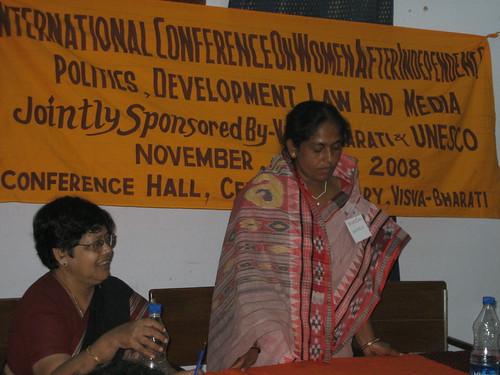
Agenda from the 2008 International Conference on Women after Independence, Visva-Bharati, November 2008

2008 International Conference On:
Women after Independence: Politics, Development, Law and Media.

Jointly sponsored by UNESCO and Women's Cell Visva-Bharati

15th- 16th November 2008


Day 1, 15th November 2008


Inauguration: Vice Chancellor, Prof. Rajat Kanta Ray

Welcome Address: Prof. Asha Mukherjee

Address by the Chief Guest: Prof. Brenda Gael McSweeney

Conference note: Sm. Swati Ganguly

Vote of Thanks: Prof. Kumkum Bhattacharya


Session I: Women and Politics

Chairperson: Prof. Maitreyi Chaudhury

Speakers:

Prof. Bonita Eleaz

Dr. Sarika Tyagi

Sri Achyut Chetan

Sm. Krishna Bandopadhyay


Session II: Women and Development with special focus on Work

Chairperson: Prof. Aparajita Mukherjee

Speakers: Prof. Mukul Mukherjee

Prof. Samita Sen

Dr. Nirmala de Abreu

Sm. Nilanjana Sengupta


Session III: Women and Development with special focus on Reproductive Health

Chairperson: Rajashri Dasgupta

Speakers

Dr. Azra Abidi

Sm. Jharna Panda


Day 2, 16th November 2008


Session IV: Women and Development with special focus on Education

Chairperson: Professor Mukul Mukherjee

Speakers:

Dr. Paromita Chakravarti

Sm. Joyeeta Bagchi


Session V: Women and Media

Chairperson: Ms. Swati Ganguly

Speakers:

Sm. Rajashri Dasgupta

Sm. Ananya Chatterjee

Sri. Abhijit Roy

Dr, Somdatta Mondal

Prof. Sutapa Bhattacharya


Session VI: Women, Law and Violence

Chairperson: Prof. Asha Mukherjee

Speakers

Dr. Ruchira Goswami

Dr. Rukmini Sen

Prof. Shamita Dasdasgupta

Sm. Anchita Ghatak


Session VII: Women and Development

Chairperson: Prof. Kumkum Bhattacharya

Speakers

Prof Brenda Gael Mc Sweeney

Presentation by members of Srihaswani Project

Sri Krishno Dey
Prof Asha Mukherjee


Valedictory

Sm Swati Ganguly

Sunday, November 23, 2008

UNITWIN Staff and Message from Sonia Bahri, UNITWIN Director - UNESCO, Paris

From left to right: Inga Nichanian, Hassmik Tortian, Sonia Bahri, Milena Caceres Valderrama, and Carmen Piñán.

From Dr. Sonia Bahri, Director of UNITWIN
: There will be no sustainable development without women's empowerment. Higher education Institutions and universities have a key role to play as think-tanks and as bridge-builders between academia and local communities, and between research outcomes and decision making, in the field of gender equality.

Today, UNITWIN has 617 UNESCO Chairs and 60 UNITWIN Networks in 125 Member States. There are 11 Chairs plus one UNITWIN Network established in Gender issues.

Dr. Brenda Gael McSweeney Awarded Order of Merit First Class from Federal Republic of Germany


Dr. Brenda Gael McSweeney pictured here with the Lady Mayor of Bonn, Baerbel Dieckmann, on the occasion of the Award Ceremony in Bonn.

Brenda was awarded the Order of Merit First Class, decided by the President of the Federal Republic of Germany, for her work in development with the United Nations and support of the creation of the 'UN City, Bonn.'

She was invited to give a lecture entitled "Making UN History in Bonn" to the development community in Bonn on the occasion of the award ceremony. The lecture focused on work accomplished by the UN Volunteers in the arena of gender and the environment globally, with specific reference to programs in Burkina Faso and India, and an accent on steps the development community in Bonn might take next.

UN Volunteers Article on Brenda's Award


Photo by Dr. B. Murali

University of Bonn Students preparing for the Model UN, New York

Model United Nations participants from the University of Bonn, Germany pictured with Brenda Gael McSweeney

Brenda met up on October 22nd at the Old Town Hall in the UN City of Bonn with a team of University of Bonn students who will be participating in the 2009 National Model UN delegation. This was on the occasion of the event, "Making UN History in Bonn", co-sponsored by the City of Bonn and the Foundation for International Dialogue of Sparkasse Bonn.

The UNITWIN Network on Gender, Culture and Development is currently exploring affiliations with the University of Bonn and Sparkassenstiftung, Bonn.

Photograph by Hee-Sun Helene Won

Wednesday, October 8, 2008

Just published by UNESCO: "Another Side of India: Gender, Culture and Development"!

Cover painting credit: © Anuradha Dey (Shantiniketan, West Bengal, India)

A Volume of Essays by participants in the UNITWIN Network on Gender, Culture and People-Centered Development. Editor - Brenda Gael McSweeney; Foreword by Gita Sen; Introduction by Krishno Dey; and a final note called 'Points of View, from the Other Side...' by social activist Aruna Roy.

Essays and Authors:

Engendering Panchayats - Niraja Gopal Jayal

She's in Charge Now: An Examination of Women's Leadership in the Panchayati Raj Institutions in Karnataka - Shiwali Patel

Public Space and Women's Rights: Fine Tuning Democracy - Kumkum Bhattacharya

Srihaswani: a gender case study - Krishno Dey, Chandana Dey and Brenda Gael McSweeney
with Rajashree Ghosh


Hold the pen-plough and till the paper-land: Success story of a movement for education and related issues - Kumar Rana, Liby T. Johnson and Subhrangsu Santra

Poverty of Choice: Gender and Livelihoods in Punjab - Yaaminey Mubayi

A Uniform Civil Code towards Gender Justice - Leila Seth

Missing Daughters: Socio-Economic and Cultural Dynamics of Adverse Sex Ratio in Punjab - Malkit Kaur

Contested Terrains: Gender Justice and Citizenship in South Asia - Shahla Haeri


Story Link
Book Link

Saturday, August 30, 2008

"Her Village is Named Daggo"

Left: Former BU Student Ashley Hughes with Oumima in Niger, Africa. Ashley participated in the Boston University Niamey Development Program from September to December 2007. In August 2008 she returned to Niger for a two-week trip to continue learning about nutrition activities in the country. While at BU, Ashley was a key actor in the creation of a new student club at Boston University called Students Against Human Trafficking, and served as its president.

"Her village is named Daggo. It sits 4 K (about 2 miles) away from the main road. When we turned off the main road we found ourselves without a road, just in a space between stalks of millet. The village is surrounded by the villagers' millet fields, their main crop and dietary staple. When we reached the village center we got out and found our way through the maze of mud walls to Natasha's house. She has only been here for 2 weeks, and she still has a hard time finding her house.

Her house is surrounded by a short mud wall that marks off her yard, or her concession. People spend most of their lives outside--even the cool mud houses get too hot, and there's no reason to stay inside for too long. The heat drives people to sleep outside, cook outside, rest outside, everything. The house is almost a prop, just a sign of wealth. Natasha's wealth is shown in other ways. She is the only village member to have a latrine (which is a hole in the ground). The villagers go in the sand and bury it. She has furniture (a table, some chairs, a cot). She also has a large house for just herself, compared to other families in the village.

I tried putting myself in her shoes. Here she is, in complete isolation from home and from a certain standard of living that we are used to. No one in the village speaks English or even French, forcing her to learn Hausa faster out of sheer necessity. For the first month of her service she is required to stay in the village without returning to the hostel in order to solidify her place in the village.

This one woman, Oumima, was Natasha's neighbor and "mother". She is about 60 or 70 years old, and she lives in the same courtyard with her co-wife. Their husband is dead, but the two live together with the youngest of their 18 children. They are both old enough that some of their kids are grown, but as per Nigerien tradition they take care of a lot of their grandchildren. Oumima wakes up at 4 am, draws water, goes to the fields all morning, comes back to make food for her family, pounds millet, works in the field more, comes back to draw water, pounds millet...the life is so repetitive and endless.

So it was hard to understand her smile, her warm hospitality, her insistence on feeding me, her encouraging words about learning Hausa. He eyes were bright and shining every time I saw her, in spite of the baby strapped on her back or the wood balanced on her head, whether she was bending over to sweep the courtyard or to tend to the fire. She had a patience about her that you never see back home. She's not anxious for things to change, she is accepting of life as it is. It hasn't changed for her and probably never will. But it does not break her spirit."