Friday, October 16, 2009

Announcing the 2010 Sikhpoint Calendar, “Conserving Sikh Heritage” from the Cultural Resource Conservation Initiative (CRCI)


Conservation Architect Gurmeet S. Rai at the Golden Temple, Amritsar, India, October 2008

"Conservation Architect Gurmeet S. Rai is the Founder and Director of the unique Cultural Resource Conservation Initiative that preserves and enhances India’s cultural heritage. CRCI effectively bridges from helping forge international and national cultural heritage policy to grassroots action, notably in Punjab and other states of India. Gurmeet is also the initiator of the Lime Centre, which works to revitalize communities through cultural heritage projects and develops inventories and cost-effective appropriate technologies. She believes strongly that conservation is a vital part of development, not, as often perceived, a peripheral activity. In addition, Gurmeet works with the United Nations World Tourism Organization as the Cultural Heritage Specialist, spearheading the master plan for tourism in Punjab. Gurmeet and the CRCI are the recipients of numerous prestigious global and local awards, and are partners in our UNESCO Chair/University Twinning Network on Gender, Culture, and People-Centered Development."

- Dr. Brenda Gael McSweeney

A preview of the 2010 CRCI Sikhpoint Calendar, "Conserving Sikh Heritage" being launched in Los Angeles in November 2009:

Kumar Rana on "Home Task"

Kumar Rana at the Pratichi Trust Annual Symposium, Shantiniketan, August 2009


'' 'Home Task' is the required period of intensive study time at home for primary school-aged children in India. As far as I know, India is the only nation in the world that mandates that her primary-aged school children must engage in extensive amounts of time devoted to their studies outside of the classroom setting. Here in West Bengal, as in most Indian states, this mandatory requirement is routinely adhered to. 

Sadly, the lack of proper 'Home Task' facilitation for poorer students throughout India is one of serious concern, leading to huge disparities between the social classes. Students who come from disadvantaged backgrounds are unable to receive assistance 'memorizing their textbooks' and doing other exercises because their families are unable to afford private tutoring, in stark contrast to their wealthier peers whose parents can afford such expenditures. 

This constrained context for economically disadvantaged children produces a clear case of class division that can only be eradicated through radical and systemic change. This change must include a major overhaul in the curriculum and syllabus of primary school education in India that will close disparities between rich and poor students. We intend to publish a study and recommendations in December, with the formal assistance and release by Professor Sen, to address this most serious disparity facing the economically disadvantaged children of India."

- Kumar Rana

Amartya Sen at the Pratichi Trust Annual Workshop on "Syllabus, Teaching, and Learning and Mid-Day Meal," Shantiniketan, 2-3 August 2009

Prof. Amartya Sen speaking at the Pratichi Trust Workshop

From Kumar Rana, Pratichi Trust:
"The Pratichi Annual Workshop on "Syllabus, Teaching and Learning and Mid-Day Meal" was held at Shantiniketan on 2-3 August, 2009. It's an event that the Pratichi Trust has been organizing since 2002, and Professor Sen has been one of the most consistent participants at this meeting. It's a platform where parents, teachers and others including policy-level people, academics, and activists interact. At the last meeting, 60 participants spoke, and of them 45 were parents and teachers. As a general rule, meetings are addressed by "big people" to be heard by the "small" ones; but our meeting turned the table around. Also, we took another radical decision - all of the four sessions were chaired by teachers and the general public, and the male/female ratio of the chairpersons was exactly 50-50."


Recurring themes:

1. The preparation of the syllabus, training modules and textbooks needs to be decentralized. Teachers have to be incorporated into this process.
2. The syllbus should be so prepared that the conception of 'home task' at the primary level - found no where in the world except the subcontinent - be abolished, without making some immediate systemic changes.
3. The mid-day meal has not yet been univerlized; this must be completed on urgent basis. Also, problems in the programme - supply, allocation, operation - need to be eradicated. The transparency mechanism that was in place in its initial days has to be brought back with added vigour.


Recap:

The Workshop "focused on the syllabus at the primary level and its connection with teaching and learning; and the implementation of the mid-day meal program, particularly at the upper primary (5 - 8 standard) stage. With 320 participants from villages across West Bengal, it was a remarkable event that opened paths for democratic dialogue in a more meaningful and effective way."


The audience at the Pratichi Trust Workshop


Tuesday, July 21, 2009

BU's Diane Balser at the University of El Salvador


Dr. Diane Balser, who teaches Women's Studies at Boston University, is just back from El Salvador. She has a longstanding relationship with the country, and this month was hosted at the University of El Salvador. Dr. Balser gave a talk on "The Crisis in Capitalism and its Effects on Patriarchy." She interacted with men and women, including students, women from women's organizations, government officials, and feminist scholars from the University in San Salvador.

For more than twenty-five years, Diane Balser has been an international trainer on women's issues and leadership development. She has led workshops for women (and women and men) in the context of this peer empowerment support networking in various locations throughout the world, including North and South America, Western and Eastern Europe, Japan, Africa, and Australia. She has given talks to conferences/seminars in South Africa, the Netherlands, Israel, and other countries.

Thus her recent work in El Salvador is very much linked to Dr. Balser's lifelong vocation leading training workshops on global issues pertaining to women's lives, and to the themes of our UNESCO/UNITWIN on Gender, Culture, and People-Centered Development.

Tuesday, June 30, 2009

Kumkum Bhattacharya, our Visva Bharti “Twin,” to attend UNESCO’s World Conference on Higher Education!


Dr. Kumkum Bhattacharya, pictured at the podium above at Visva Bharti University’s UNITWIN International Conference in West Bengal, India, has been invited to attend UNESCO’s forthcoming WCHE in Paris.

For the UNESCO Conference exhibition, Kumkum is planning to share material related to ideas of Rabindranath Tagore, the founder of Visva Bharati, on higher education and his focus on rural reconstruction as being central to the idea of self-sufficiency. The themes of our UNITWIN - gender, culture, and people-centred development - will surely permeate Kumkum’s presentations!

Monday, May 11, 2009

Gearing up for UNESCO's World Conference on Higher Education!

UNESCO'S UNITWIN team, that hosts our Gender, Culture, and People-Centered Development Network, is gearing up for participation in UNESCO'S World Conference on Higher Education. The gathering in Paris will focus on 'the new dynamics of higher education and research for societal change and development.' (5-8 July, 2009).

The UNESCO/HQ UNITWIN team, directed by Dr. Sonia Bahri, is pictured here in late 2008 on the occasion of meetings with Dr. Brenda McSweeney, initiator of the UNESCO/UNITWIN on Gender, Culture, and Development. From left to right: Carmen Piñán, Ariana Stahmer, Milena Caceres Valderrama, Brenda Gael McSweeney, Sonia Bahri, Inga Nichanian, Natalia Buga and Yoo Lee Miyon.

Since gender equality is one of UNESCO's two organizational priorities, the perspective of equity, access, and quality will be examined during the Conference debates.

Wednesday, April 22, 2009

Deborah Belle to Serve as Principal Investigator on $750,000 Grant to BU to Strengthen Women’s Professional Networks in Science and Engineering

(Boston) – The National Science Foundation (NSF) has awarded a three-year grant to Boston University for a project to help women faculty in the sciences and engineering strengthen their professional networks as a method of improving their career success and satisfaction at the University. BU received the [$750,000] grant as part of the NSF ADVANCE program, which helps universities develop systemic approaches to increasing representation and advancement of women faculty in science and engineering careers. Deborah Belle, the principal investigator of the study, is the Interim Director of the Women’s Studies Program that anchors the UNESCO/UNITWIN on Gender, Culture and People-Centered Development.

Science and engineering departments in U.S. universities continue to lose highly accomplished women to industry and to other non-academic careers, even as women represent an increasing percentage of those who earn doctoral degrees in STEM (science, technology, engineering, and mathematics) disciplines. Boston University is no exception. Despite hiring increases at Boston University, the overall percentages of women in natural science and engineering departments at Boston University have remained flat over the past decade.

Research has shown that faculty women in the sciences and engineering often have networks ill-suited to professional development, collaboration, productivity, or high morale. Beyond their own departments, women faculty tend to have fewer ties than do men of comparable rank, resulting in fewer channels through which they might receive information about new scientific discoveries, funding opportunities, or methods of research, or through which they might become known and valued in their fields.

“WIN: Women in Networks, Building Community and Gaining Voice” will adapt programs from other ADVANCE schools and develop new BU programs that will strengthen professional networks to enhance the success and satisfaction of women faculty. In addition, grant allocations will invigorate faculty networks in the science, technology, and engineering disciplines and support new collaborative research ventures. The centerpiece of the project is an analysis of the networks of faculty members in the College of Arts and Sciences (CAS), College of Engineering, and Sargent College, and the potential connection between network changes over time and the retention and promotion of women faculty in science and engineering.

“Analyzing the impact of social networks on improving the career success and satisfaction of women faculty is truly innovative,” explains principal investigator Deborah Belle, also CAS professor of psychology.

Belle notes that the study’s findings may have broader implications for non-academic workplaces and other academic disciplines. The grant will also fund more than 20 collaborative projects in a broad range of science, technology, engineering, and math fields, launching new research spearheaded by women Network analysis tools and techniques developed in this study will be made available to other researchers and institutions.

The overarching goal of the study is to create a rich community at BU, adds Belle. “Women in science and engineering tend to feel marginalized and isolated. We hope to build a professional community where people interact, are intellectually engaged, and feel more at home.”

By Amy Biderman and Deborah Belle

Monday, December 8, 2008

My Name is Kaamaylaa: Presentation at Visva Bharati

My name is Kaamaylaa.
The name of my project is Sreehasani [sic]. Sreehasani means "Creative manual skills for self-reliance".

I have been working for 10 years in 9 villages (3 Muslim, 3 Hindu and 3 Santhal Villages) in 3 communities. The villages are Saatt tore, Khiruli, Kendradangal with Muslim community; Taltore, Darposhila, Baadh baubo with Hindu community; Baansh pukur, Kauaayte pukur, Bidya dharpur with Santhal community.

Our objective has been to create awareness, mainly about:
Health,
Nutrition related organic farming in household garden patch,
Handcrafts
Environment
Culture
through several group-oriented activities.

Our main activities for Nutrition related organic gardening, has been:

a) To support 15 families in each village, to start nutrition related vegetable garden, through organic farming.
b) To become aware nutritional value in vegetables.
c) To cook nutritional vegetables and gain knowledge about several recipes of nutritional values of such vegetables.

My main responsibility is to look into the nutritional factor. When I first met the mothers in the community, they were not even aware of the word "Nutrition." I showed them pictures of vegetables with their nutritional values and discussed about nutrition. They learned about the components of Sugar, Proteins, Vitamins, Fat, Iron, Salt and Water in vegetables. For example, they came to know about 6 divisions of Vitamins... A, B, C, D, E, and K.

The groups learned to cook 35 varieties of nutritional vegetable recipes. They also learned to cook 2 or 3 oil free recipes.

The groups learned the names of the vegetables that were grown in their organic vegetable garden and trained to plant herbal trees for medicine purposes on the bamboo fences of their houses.

Most of the families had Papaya trees in their garden, but the papayas on the tree were mostly wasted. The groups were trained to make food like Haaluwa and Morobba with papaya. Now these trained groups come to the center and train other new groups.

So far, awareness of vegetable organic gardening and nutrition has spread among 200 households in the nine villages.
There are now about 200 organic vegetable gardens in the nine villages.
The groups now have the knowledge about nutrition and can discuss with others about the good qualities and nutritional values of organic vegetables in the garden.

Photo by Brenda Gael McSweeney

Gender, Peace, and Conflict by Dr. Arvinder Ansari

Presented November 15, 2008 at the Visva-Bharati International Conference on Women

"Women bear multiple identities and these identities are defined and re-defined in context of nation, race, gender, community and ethnicity. it is a well-recognized fact that women suffer in social-conflict on account of their gender and on account of their religion. Women may serve as the symbolic figuration of a nation. They are also seen as embodiments of male honour and as such become a site of contestation for this honour. Hence, the defense of women and children becomes and rallying slogan of men going to war, as women from opposing factions fall victim to rape and other sexual atrocities when represented as guardians of the 'race' and nation.

Women not only signify and demarcate juridical, political, cultural and psychic boundaries of a national collectivity, but they inscribe these boundaries in and through a myriad of cultural practices, their assumption of particular feminized subject positions, their relationship to the upbringing of children and involvement in religious and other ritualistic practices that construct and reproduce particular nations of tradition.

Women are considered a property and their sexuality is the most prized possession of the patriarch she suffers during the collective violence due to her sexuality and in the aftermath on account of her gender. During the times of collective-violence, ethnic-conflict and civil war, women become target of attack not as women but as the property of the Patriarch or as the icon of community honour. Women's sexuality is here attacked so as to teach men of the community a lesson that, as the natural guardians of women, they are not able to protect their women and must suffer the loss of their social property.

Women are very important for the reconstruction of the community. It is true that they witness the killing of their male members: their kith and kin are wiped out and the entire fabric of their socio-cultural existence is torn asunder. Women are left companionless and shelter-less and thrown into an alien environment. Under riot-torn conditions, when women's emotional and material world is destroyed, they are left with additional burdens. Thus, violence and social conflict not only affect women physically but also increases their responsibilities. As the scale of ethnic and social-conflict causalities has risen, both women's suffering and their responsibilities have increased.

Making visible women's experiences in situations of violent conflict, their agency in managing survival and reconstruction and women's notions of security and peace, is necessary to get due recognition for women's experiences as a resource and a space in formal politics for mainstreaming gender in the peace building process."

Dr. Arvinder A. Ansari
Associate Professor
Department of Sociology
Jamia Millia Islamia

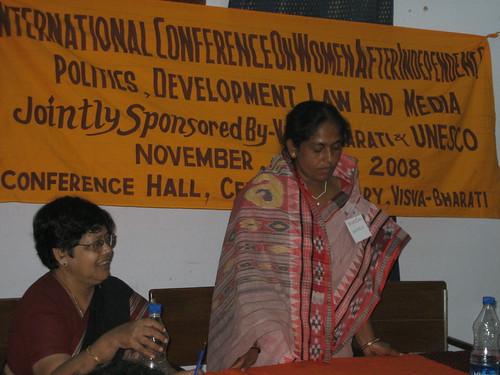
Agenda from the 2008 International Conference on Women after Independence, Visva-Bharati, November 2008

2008 International Conference On:
Women after Independence: Politics, Development, Law and Media.

Jointly sponsored by UNESCO and Women's Cell Visva-Bharati

15th- 16th November 2008


Day 1, 15th November 2008


Inauguration: Vice Chancellor, Prof. Rajat Kanta Ray

Welcome Address: Prof. Asha Mukherjee

Address by the Chief Guest: Prof. Brenda Gael McSweeney

Conference note: Sm. Swati Ganguly

Vote of Thanks: Prof. Kumkum Bhattacharya


Session I: Women and Politics

Chairperson: Prof. Maitreyi Chaudhury

Speakers:

Prof. Bonita Eleaz

Dr. Sarika Tyagi

Sri Achyut Chetan

Sm. Krishna Bandopadhyay


Session II: Women and Development with special focus on Work

Chairperson: Prof. Aparajita Mukherjee

Speakers: Prof. Mukul Mukherjee

Prof. Samita Sen

Dr. Nirmala de Abreu

Sm. Nilanjana Sengupta


Session III: Women and Development with special focus on Reproductive Health

Chairperson: Rajashri Dasgupta

Speakers

Dr. Azra Abidi

Sm. Jharna Panda


Day 2, 16th November 2008


Session IV: Women and Development with special focus on Education

Chairperson: Professor Mukul Mukherjee

Speakers:

Dr. Paromita Chakravarti

Sm. Joyeeta Bagchi


Session V: Women and Media

Chairperson: Ms. Swati Ganguly

Speakers:

Sm. Rajashri Dasgupta

Sm. Ananya Chatterjee

Sri. Abhijit Roy

Dr, Somdatta Mondal

Prof. Sutapa Bhattacharya


Session VI: Women, Law and Violence

Chairperson: Prof. Asha Mukherjee

Speakers

Dr. Ruchira Goswami

Dr. Rukmini Sen

Prof. Shamita Dasdasgupta

Sm. Anchita Ghatak


Session VII: Women and Development

Chairperson: Prof. Kumkum Bhattacharya

Speakers

Prof Brenda Gael Mc Sweeney

Presentation by members of Srihaswani Project

Sri Krishno Dey
Prof Asha Mukherjee


Valedictory

Sm Swati Ganguly